
Applications
Conveyor Solutions for Different Loading Applications
Different loading environments require different conveyor configurations. Start with your loading height, vehicle dimensions and cargo characteristics, then review the equipment options that may suit your application.
- 6 industries
- 3 loading scenarios
- Trade-offs explained
Scenario to line decision guide
Start on the left with the constraint you cannot change. Where two lines could work, the deciding factor is cargo shape or equipment cost, and both are called out.
| If your site… | Recommended line | Deciding factor |
|---|---|---|
| Has a dock and the trailer sits level with it | Telescopic Roller Conveyor | For sites with a loading dock where the trailer floor sits level with the platform, and for flat in-plant transport. |
| Loads from the ground with no dock | Hydraulic Lift & Incline Conveyor | For ground-level loading without a loading dock. |
| Receives a mixed fleet across the same door | Hydraulic Lift & Incline Conveyor | Suits all vehicle body types below 17.5 m semi-trailers, and handles both light and heavy cargo. |
| Handles high-volume mixed parcels | Telescopic Belt Conveyor | Built for express and logistics parks and cargo with mixed package types and sizes; works with or without a loading dock. |
| Needs the same line with and without a dock | Telescopic Belt Conveyor | Available in both setups: mobile high stand plus hydraulic lift arm for no-dock use |
| Loading or unloading 20 ft and 40 ft containers | Telescopic Roller Conveyor or Belt Conveyor | Roller for uniform cargo, belt for mixed sizes; tell us whether the container is on the ground or at the dock |
Three loading scenarios
Scenario 1
Loading through a dock
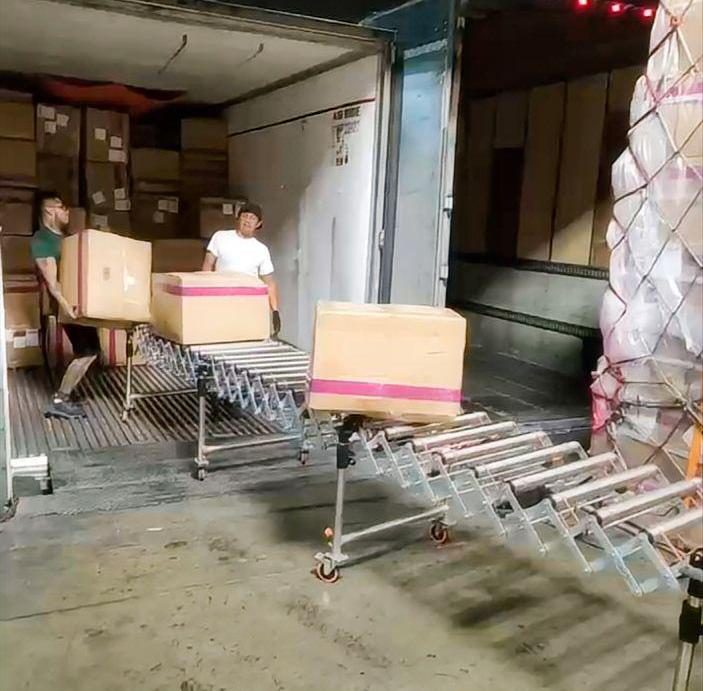
The trailer floor already meets your platform, so no lifting section is needed. The job is purely horizontal: get cargo from your despatch point to the far end of the body without people walking back and forth.
This is where a telescopic roller line earns its keep, typically the simplest configuration where a suitable dock already exists.
Scenario 2
Loading from the yard
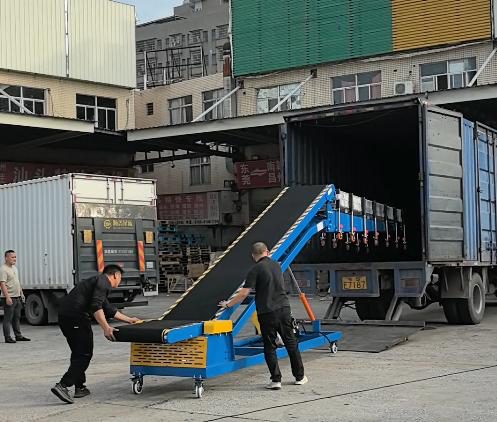
No platform, no pit, often nothing but compacted ground. Whatever you specify has to create the height itself, which is why the hydraulic line exists.
For ground-level loading without a loading dock.
Scenario 3
Loading containers
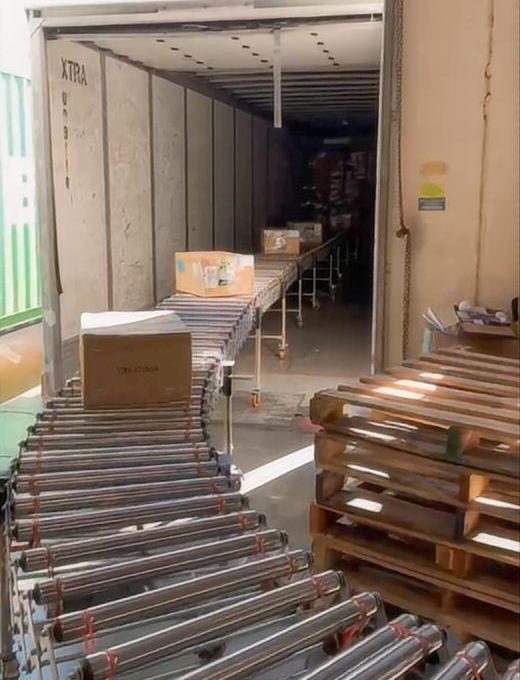
Containers punish short lines: the door line is rarely where you stop working. Reach depth dominates everything else, and whether the container sits on the ground or at a dock decides which family you start from.
Built for express and logistics parks and cargo with mixed package types and sizes; works with or without a loading dock.
Applications by industry
Parcel and Express Logistics
For suitable parcel-handling operations where packages need to be conveyed between warehouse areas and vehicles. Conveyor selection depends on parcel dimensions, weight, stability and required throughput.
E-commerce Fulfillment
For suitable outbound operations handling cartons, parcels and other packaged goods. The conveying surface and dimensions should match the package characteristics and workflow.
Bagged Grain and Feed
For suitable bagged agricultural products handled in loading and dispatch areas. Roller surface selection and load capacity must be confirmed against bag dimensions, weight and handling requirements.
Manufacturing and Distribution
For factories and distribution facilities that need to move suitable packaged products into vehicles. The configuration depends on the cargo and loading process.
Freight and Logistics Hubs
For suitable cargo-handling operations that require flexible reach into vehicle loading areas. Vehicle compatibility and required throughput should be confirmed.
Building Materials
For suitable packaged building materials, subject to the equipment's rated load, package dimensions and structural limitations. Heavy or irregular loads require specific technical review.
What usually goes wrong
Most mis-specifications are not engineering failures; they are a missing measurement at the start. These are the ones worth double-checking before you ask for a proposal.
- Measuring dock height with a laden truck rather than an empty one, because the difference changes everything
- Forgetting the longest body that ever arrives, not the one that arrives daily
- Assuming the ground outside is level and firm enough to stand a mobile unit on
- Overlooking where the machine will park when nothing is loading
- Choosing rollers for cargo that is soft, small or irregularly shaped
- Not checking available power before the unit is specified
Applications FAQ
Can the belt conveyor serve both dock and ground-level loading?
The belt line is offered in two configurations: fixed at a dock, or on a mobile high stand with a hydraulic lift arm. The configuration is specified at order stage; a unit built for one setup is not switched to the other without modification. Roller and hydraulic lines each serve one of the two cases.
We receive several vehicle types. Does that rule one line out?
Suits all vehicle body types below 17.5 m semi-trailers, and handles both light and heavy cargo. Coverage means body lengths up to 17.5 m semi-trailers; longer or unusual bodies are reviewed case by case.
Which line suits export container work best?
Uniform cargo favours the roller line, mixed cargo favours the belt line. Whether the container sits at a dock or on the ground decides if you need the hydraulic line instead.
Our yard surface is uneven. Options?
Send photos of the yard where the unit would stand. Surface condition is one of the inputs used to decide the mobile base setup.
We only need extra capacity at peak. Is a temporary unit practical?
Mobile setups are often used for seasonal peaks. Tell us the peak window, the door you would use and your volumes, and we will confirm whether a mobile configuration is practical for your operation.
Tell Us About Your Loading Needs
Dock height, vehicle mix and cargo. Our team will recommend a suitable configuration and follow up with product information.
Get a Free Quote